HOW A SHOPIFY STORE REACHES ONE HUNDRED ON MOBILE
THE LAST POINT BELONGS TO THE NETWORK. KNOW WHO HOLDS IT.
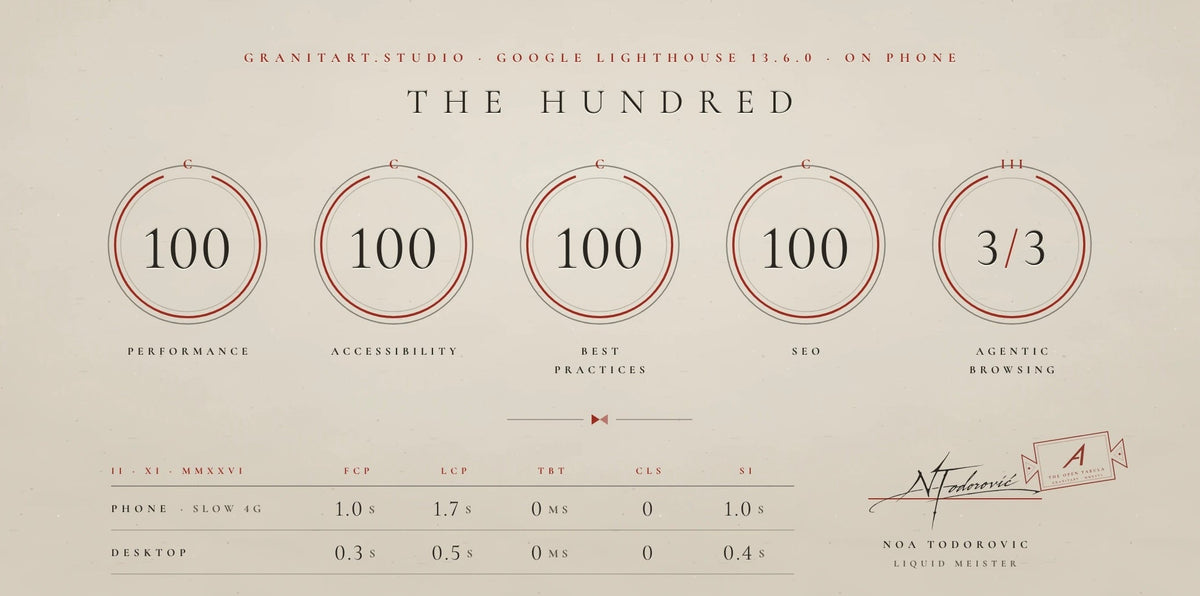
This tabula was first published as “Why no Shopify store reaches one hundred on mobile”. It argued that a store written by hand could reach 99 in Google Lighthouse on mobile, and that the last point belonged to the network and the platform. On 31 October 2026 the house proved itself wrong by one point: the home page of granitart.studio scored 100 on mobile in performance, accessibility, best practices and SEO, with no apps.
The last point was never the platform’s. It was hiding in the frames after the first paint.
What the mobile test measures
PageSpeed Insights runs Lighthouse twice, once as a phone and once as a desktop. The mobile run emulates a Moto G Power on a slow 4G network: 150 milliseconds of latency, about 1.6 megabits per second, and a processor slowed four times. It is a stress test, built to show how a page behaves for the slowest serious visitor.
The performance score is a weighted sum of five measurements:
- Total Blocking Time, 30 percent: how long scripts keep the page from responding;
- Largest Contentful Paint, 25 percent: when the largest element appears;
- Cumulative Layout Shift, 25 percent: how much the page moves while it loads;
- First Contentful Paint, 10 percent: when anything first appears;
- Speed Index, 10 percent: how quickly the screen fills.
Each is scored on a curve. A page with no blocking and no movement already holds 55 of the 100 points. The other 45 ride on the first paint, the largest paint and the Speed Index, and the score rounds to 100 only when those three together keep almost all of theirs.
Where the last point was hiding
Lighthouse does not slow the page down and watch it. It loads the page once at full speed, records it, and then calculates how the same load would unfold on the slow phone. Speed Index is drawn in large part from that recording and weighted up for the slower phone, so every change on the first screen after it has painted is paid for again.
At 99 the first paints of the house were already fast. The point was lost after them: in a notice that rose over the page on a timer, and in weight the page carried without needing it, at the very top of the first screen.
What the house changed
- The cookie notice no longer rises on a timer. It waits for the first movement of the visitor, a touch, a scroll or a key, so it never stands in the first screen the test records.
- The mark in the header, the largest element of the first screen, was redrawn. The traced wordmark weighed 17.7 KB; the new mark of the house, an arch with a keystone of gold, weighs 2.3 KB and stands at the same height.
- Every drawing leaves the house without hidden weight. The metadata that design tools write into SVG files, up to 7.7 KB per mark, never paints, and it was removed.
- The signature of the Meister Architect is sent once. Where it appears twice on a page, the second is copied from the first instead of travelling again.
None of it changed how the house looks. It changed what arrives, and when.
Nothing in the store that the store does not use.
The law of the house
What still costs a Shopify store the most
Most stores lose their points to themselves. Every app adds its own scripts, styles and tracking to every page, whether the visitor needs them or not. Premium themes ship code for features the store will never use. Page builders wrap simple content in layers of markup. That is still the distance between 80 and 99.
The last point is a discipline of the first second: nothing that waits, nothing that rises, nothing that redraws what the visitor already sees. Liquid, the template language of Shopify, allows all of it, and a store written entirely in Liquid carries only what it uses.
The lab score and real speed
The mobile score remains a laboratory number. It describes an older phone on a weak connection, not the visitor who opens the store on a recent phone over fast Wi-Fi, who meets something far closer to the desktop result. Google measures real visitors separately, in the field data Chrome collects. A hundred in the laboratory is not a promise about every visit. It is proof that nothing in the page stands in its own way.
The record
- Mobile test: Lighthouse 13.6.0 in PageSpeed Insights, emulated Moto G Power, slow 4G (150 ms, about 1.6 Mbps), processor slowed four times.
- Score weights: Total Blocking Time 30%, Largest Contentful Paint 25%, Cumulative Layout Shift 25%, First Contentful Paint 10%, Speed Index 10%.
- For 100 on mobile: no blocking time, no layout shift, an early first and largest paint, and a first screen that does not change after it has painted.
- What held the last point: a notice rising on a timer over the first screen, and weight the page never needed: a traced mark, hidden metadata, a signature sent twice.
- Outside the control of the theme: server response, network travel and the scripts Shopify adds to every storefront. They did not stand in the way.
- granitart.studio, 21 October 2026: mobile 99, desktop 100 in all four categories.
- granitart.studio, 31 October 2026: mobile 100 in performance, accessibility, best practices and SEO, with no apps.